
The sequel to the Oscar-winning 2019 “Joker” fails on many levels. “Joker: Folie à Deux” attempts to bring a jukebox musical into a trial tragedy, yet both the courtroom drama and the musical madness fail to form a cohesive whole. The result is neither a good musical nor a good legal procedural drama and Lady Gaga’s talent as an actress and a singer are both wasted.
The title references a couple and the term “folie à deux” refers to a mental illness shared by two people who are closely associated. In this case, from the Batcave intelligence, it would mean the Joker and his paramour Harley Quinn.
If you haven’t seen the 2019 film, directed and written by Todd Phillips (with Scott Silver) that won Best Actor for Joaquin Phoenix and Best Original Score for Hildur Guðnadóttir, I have a synopsis for you or you can read my full review (link provided below). Both Phoenix and Guðnadóttir also won BAFTAs for “Joker” in 2020 and Shayna Markowitz won for Best Casting.
There is a lot of exposition during the sequel. I found it to be almost too much info.
Joker
“Joker” is the origin story of Arthur Fleck as the Joker or is it? Arthur is a mentally ill, failed stand-up comedian who works as a party clown, but gets beat up by different groups of boys/men. He imagines a relationship with a neighbor (Zazie Beetz as Sophie) just as his mother Penny (Frances Conroy) imagines that her adopted son is her biological son fathered by billionaire Thomas Wayne (Brett Cullen). That would make Bruce Wayne (Dante Pereira-Olson) Arthur’s half-brother if it were true.
When three drunk employees of Wayne Investments assault Arthur–still dressed up as a clown–on the subway, Arthur fatally shoots two of them in self-defense and then pursues and guns down the third. In this horrifically crime-ridden Gotham, Arthur’s clown becomes a folk hero for the disaffected. People begin wearing similar clown masks and costumes as a tribute to anarchy. Arthur is famous incognito, but his attempt at fame in front of an audience as himself, fails so spectacularly that he comes to the attention of his idol, Murray Franklin (Robert DeNiro), a late-night talk show host who inadvertently gives Arthur his villain name and then invites Arthur on his show. What Murray Franklin doesn’t know is that budget cuts have left Arthur without his medication.
After confessing to the subway murders on live television, Arthur murders Murray Franklin, sparking a riot. During the riots, Thomas Wayne and his wife are murdered, orphaning Bruce Wayne.
Joker: Folie à Deux
Written by Todd Phillips and Scott Silver and directed by Todd Phillips, the film begins with an animated short with Looney Tunes vibes (animated by Sylvain Chomet, “The Triplets of Belleville”). The Joker is fighting and framed by his shadow on a live television show. Yet behind the curtains, we transition into a grim reality of a poorly funded hospital with a secure ward where the guards majored in brutality. Arthur Fleck is in greenish glow of Arkham Asylum awaiting trial for the crimes he committed two years earlier. Fleck is still gaunt but seems to have lost any notion of hope or horror.
One of the guards, Jackie Sullivan (Brendan Gleeson), whistles the traditional “Oh, When the Saints Go Marching In” but the film is saturated with musical gems from the past.
If Fleck tells a joke, the guard will reward him with a cigarette, but remember, Fleck’s jokes aren’t funny.
The inmates in E Ward are the dangerous ones, but Fleck is brought past Ward B where he sees a group of inmates singing. A woman makes eye contact: Harleen “Lee” Quintal (Lady Gaga). Fleck is getting shaved and ready to meet with his attorney.
In an unusual step, Fleck is allowed to join this group activity and is told by the lead counselor, “We use music in this class to make us whole.”
Arthur Fleck falls in love or lust with with Harleen who tells him the criminal act that got her institutionalized was “I set fire to my parents’ apartment building.” Yet is this real or is this like his fully imagined romance with his neighbor Sophie? After a fire during an inmate movie screening, Harlan is expelled to prevent her from being influenced by Fleck.
Fleck’s attorney, Maryanne Stewart (Catherine Keener), hopes to get Fleck off on the basis of an insanity plea. Dent has different ideas. I’m not convinced allowing a popular TV personality to interview Fleck in Arkham is the right move, but it allows Fleck to sing to a Harleen through the television.
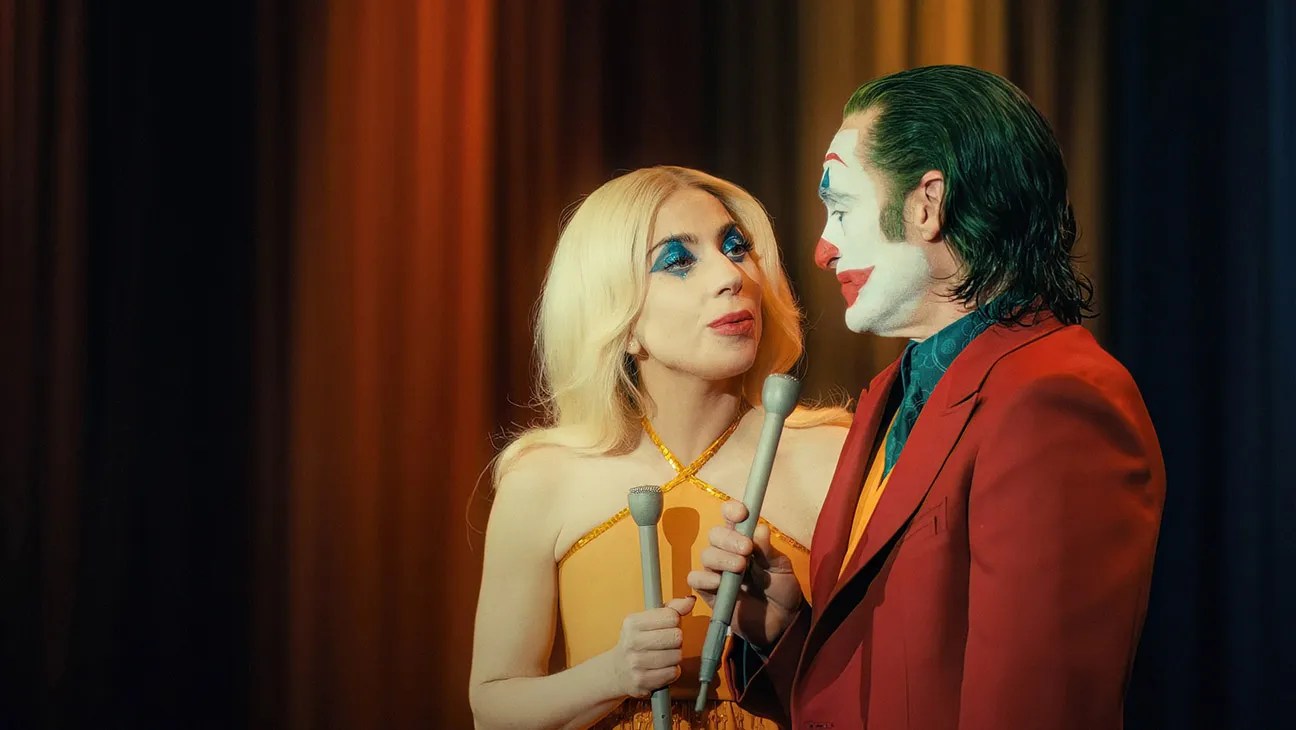
At times, Fleck imagines that he and Harleen are co-hosts of a variety show. For people who are old enough or total Cher fans, think of the old “The Sonny & Cher Comedy Hour” variety show (1970-1974) on CBS. Post-divorce, the two returned for two seasons for “The Sonny & Cher Show” (1976-1977).
In E Ward, we feel not only the presence of Assistant District Attorney Harvey Dent (Harry Lawtey) but also the Warner Bros. Looney Tunes character Pepé Le Pew and Penelope Pussycat via the television the inmates watch. Did Pepé ever find true love? Will Arthur?
Unlike the sometimes lewd but cautiously still family friendly Looney Tunes, there will be sexual intercourse depicted and more deaths. The film will earn its R-rating.
In some ways, the filmmakers are trying to go the route of some productions of “Cabaret,” where the singers are more emotive than professionally perfect. That helps with Phoenix’s character, never having to match the power of Lady Gaga’s vocals, but it also holds Lady Gaga back.
Musicals do not have to be light and frothy. Think of Stephen Sondheim’s 1990 “Assassins,” a musical about people who attempted to assassinate US presidents. Or Sondheim and Hugh Wheeler’s 1979 “Sweeney Todd: The Demon Barber of Fleet Street” or Adam Guettel and Tina Landau’s 1996 “Floyd Collins” which the failed rescue attempt of a Kentucky cave explorer. Yet all of those musicals were filled with wit and a satisfying emotional structure. Despite the topics of death and murder (or in the case of “Cabaret” the European Holocaust), there were moments that elicited laughter in the viewing audiences.
In a courtroom drama, one would expect the building of something like righteous indignation or horror at injustice. There’s none of that in the plot although we’re supposed to sympathize with Fleck being treated so harshly by the guards. Yet it doesn’t make sense that prisoners waiting trials should be house in the same institute as patients who are checked in by their parents or themselves.
There are wonderful transitions in this film, but the story bogs down in its repetitive nature. The overall structure follows neither the ways of a musical nor a courtroom drama. Instead of building up to an emotional center that is resolved, the plotting depends more upon fires and explosions to punctuate the plot. Neither Fleck nor Harleen are sympathetic. Gotham is an ugly world without heroes and humor. Not even Dent comes off as a hero.
After watching the film as I mused over the wonderful catalog of songs, I was reminded of the 1985 film “Clue,” which was an okay film, but was the inspiration for a wonderfully hilarious stage play. Maybe this film will inspire an on-stage musical that will edit down the excess.
“Joker: Folie à Deux” premiered at the 81st Venice international Film Festival on 4 September 2024 and is scheduled to be released 4 October 2024.
 The Dragon Lady Files