
While at first “The Concierge at Hokkyoku Department Store” (北極百貨店のコンシェルジュさん) seems like a whimsical animation, a merging of the Japanese coming-of-age in the workplace TV programs (e.g. “Atelier”) and the anthropomorphization fantasies like Walt Disney Studios Motion Pictures’ “Zootopia,” but as it progresses, there’s a bittersweetness flavoring to this family fare.
Our main character Akino (秋乃) is a concierge in training at a department store that serves animals of all kinds from giraffes to opossums to other animals you might not be familiar with, even if you frequent zoos. The film actually begins with Akino as a young girl wandering in wonder as she sees the beauty and vastness of the Hokkyoku Department Store. She meets a young concierge, Mori (森), voiced by Megumi Han. As a young woman, she returns and trains under Mori.
The concierge trainees and everyone seems to be under the watchful eye of Tōdō (東堂). Yet the big boss is Elulu (voiced by Takeo Otsuka) is a bird. Akino’s first faux pas involves her literally putting her foot on Elulu, leaving her footprint on his back. He’s much smaller than him. Her second, faux pas is calling him a penguin.
Almost all the concierges are women, and Eruru is the only non-human in management. Perhaps things were different in the past. Due to the department being busy, a retired concierge Maruki (丸木), voiced by Eiji Yoshitomi, has been called in to help out. He has an impressive rolodex, but perhaps the rolodex is an outdated office device. Newer generations may think it quaint and one almost believes that Maruki is himself, outdated.
Yet a good concierge is one who sees beyond the immediate for “those who can’t see the big picture will never make a good concierge.”

Akino’s adventures are episodic but show her character gaining both wisdom and confidence in the ways of representing the company while pleasing the customers. She finds a way to help a ferret please his client, the Laughing Owl husband (Dunshun Tatekawa) through his wife (Sumi Shimamoto). Akino learns how to handle public displays of affection between a peacock couple (voiced by Hiroki Nanami and Marika Kano), even using it to her advantage when she must prevent a Sea Mink daughter (Minako Kotobuki) from seeing her father (Hiroshi Yanaka). She helps in the courtship of a Japanese Wolf (Miyu Irino) and his intended (Kana Kanazawa) and a Barbary lion (Ayumu Murase) and his sweetheart (Emiri Suyama).
If you’ve never been to a Japanese department store, you won’t understand what inspires such awe. You might simply be thinking of a large store with maybe two or three floors like a Macy’s. Maybe you’ve been to some of the bigger stores like the old Marshall Field and Company on State Street in the Chicago Loop (now Macy’s on State Street since 2006) which is 13 stories or the British luxury department store Harrods in London. If you got lost in a US department store like Macy’s consider that Harrods is a five-acre site with over 300 departments.
Some Japanese department stores began as clothing stores such as Mitsubishi (三越) which began as a kimono shop as did Matsuzakaya (松坂屋 ) and Takashimaya (高島屋 ) and then expanded. Yet railway companies also had a hand in the development of department stores. “The urban development of Tokyo in the 20th century clustered around the six biggest train stations on the Yamanote line – Shibuya, Shinjuku, Ikebukuro, Ueno, Tokyo and Shinagawa – and from the off, the railway companies wanted a slice of the retailing pie….To exploit the captive market passing through their stations every day, each of the train companies built a department store outside the main entrance to its station.”
Clothing was a main stay, of course, but the basements were often devoted to food, with different vendors selling everything from tea to cheese to bakery good and miso. There was likely restaurants on the top floors and a floor devoted to crafts and art galleries with changing exhibitions from both Japan and foreign places. The article in Japan Today (25 May 2021 )notes: “Tokyo’s department stores also tend to offer a wider range of services than you’d find in a European or American department store, such as foreign exchange, travel services and concert tickets. There is usually a grocery and food court in the basement level, a garden and children’s play area on the roof and many of them also have art galleries.” When I was an exchange student in Japan, I saw exhibitions on Japanese artists as well as famous European and American artists such as Pablo Picasso and Andy Warhol. There was a display of US muscle cars and other 1950s artifacts and art or pieces on loan from famous art museums such as the Museum of Fine Arts Boston. I used to visit Shibuya at least once a month just to see the art exhibitions.
Yet the internet and the pandemic have changed things. The Japan Today article was written in May of 2021. The Tokyu Department Store at the Shibuya train station closed on 31 January 2023. For me, not having been to Japan in almost a decade, it’s hard to imagine a Shibuya with out this department store.
Because of the link between train companies and major department stores, a recent article in BrandingAsia.com (by Xiaochen Su and published 20 February 2023) notes: “The closure of department stores, normally located near major public transport nodes, has in turn hollowed out city centers across the country, forcing residents to shift toward suburban shopping centers only accessible by cars.” The Japan I used to know was a place where cars were a luxury and seemed almost unnecessary.
Su concludes that “As department stores slowly become a concept of the past in Japan, their operators will need to reinvent themselves constantly to keep up with the ever-shifting retail landscape of the future.”
The manga series “The Concierge at the Hokkyoku Department Store” (北極百貨店のコンシェルジュさん) on which this fantasy film is based was written by Tsuchika Nishimura and published as a serial in a magazine (Big Comic Zōkan) from February 2017 to November 2018, before the closure of the Tokyu Shibuya store, but as the department stores were feeling a decline.
While perhaps the decline of department stores in Japan was not part of the original theme, it does make the film more poignant as we learn that the animals here are Very Important Animals who may exist nowhere else. Eruru, the Great Auk notes that his grandfather’s library which dominates his office areas contains “the history of all species, even records of animals that are extinct.”
Yet Akino is told, “You allowed the customer’s demands to escalate and made her unreasonable. and above all you ruined the shopping experience for other customers.”
Even the demanding Caribbean monk seal matron seems more sympathetic when we learn “The Caribbean monk seals live in the Caribbean Sea. Their lack of caution made them easy prey for hunters who sought their fat for machinery oil. They became extinct in 1952. Too much kindness will only lead to self-destruction.”
Those New Zealand Laughing owls, “whose voices sound like peals of laughter were last seen in South Canterbury in 1914. Now extinct.” While the film doesn’t say how this happened, according to Britannica, it was the “cats, rats, goats and weasels” brought into New Zealand from other countries that killed them off (human-induced).
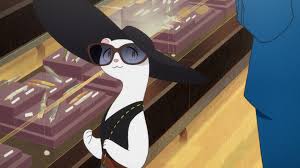
The sea mink were hunted for their luxurious fur and disappeared in 1880. The sea mink were native to the Eastern coast of North America along the Gulf of Maine.
- The Story of the Forgotten Sea Mink: This Large Animal Once Populated Our Shores
- The Extinct Sea Mink

And extinction of species isn’t just something that happened outside of Japan. “The Japanese wolves prospered in Japan. We know very little about them. They became extinct in 1905.”
- Japan at a Glance
- Japanese Wolf Perhaps Not Extinct, But Proof Remains Elusive
- The Despairing Howl Before Extinction: ‘Princess Mononoke’
As for Eruru, we learn from Tokiwa that “Great Auks were overhunted for their meat and fat. In 1830, only 50 were reported to be alive, but they were all killed by humans to make specimen samples. and became extinct in 1844.” Eruru notes, ” The first department store in the world was established in the same year” and that began an age where, his companion says, “humans began to acquire things not out of necessity, but desire.”
According to Britannica, “they bred in colonies on rocky islands off North Atlantic coasts (St. Kilda, the Faroe Islands, Iceland, and Funk Island off Newfoundland); subfossil remains have been found as far south as Florida, Spain, and Italy.”
Eruru explains that this department store was created to serve VIAs who were forced into extinction by humans, “to pass down our story of struggle to future generations and to give humans a chance to atone for their sins.” It is a “fantasy theme park that allows VIAs to become mass consumers.”
To fully understand the beauty of the illustrations and character designs (Chiyo Morita) and Satomi Ōshima’s screenplay as well as Tsuchika Nishimura’s original concepts, it’s worth noting some of the character names. The first two characters of the department store (北極) mean arctic or North Pole. Tōdō (東堂)means “East Hall.” The name Iwase (岩瀬) recalls nature with “iwa” meaning “rock” and “se” meaning “rapids.” The surname “Mori” is common enough, but the anime shows the department store prominently features a stylized green tree and the name “Mori” consists of three trees. The name of the older man, Maruki, also has a “tree” connection because means “Maru” means “circle” and “ki” means “tree.” The name “Akino” is also directly related to trees. “Aki” means autumn and the radical is “nogi” which means the katakana syllabary “no” and the Chinese character for tree. The other part of “Aki” is the Chinese character for “fire.”
In 2022, manga series won the Excellence Award at the 25th Japan Media Arts Festival.
Director Yoshimi Itazu was the key animator for “The Boy and the Heron” and “The Wind Rises.” This is a gentle film with a message that is lightly served by Tsuchika Nishimura and Satomi Ōshima’s script. The film seems to ask us to not consider human beings so much masters of the universe, but rather conservators of the land, facilitating the happy lives of all the inhabitants of our worlds and never forgetting the follies and forever lost fauna of the past.
The anime film, “The Concierge at Hokkyoku Department Store,” was released on 20 October 2023. Crunchyroll is releasing the film in the US for one-day only, 11 September 2024, at select theaters.
 The Dragon Lady Files